Mapping the Work Behind the Org Chart
The Work Catalog connects recurring activities with the role types and teams that perform them, creating a clearer basis for organisational change.
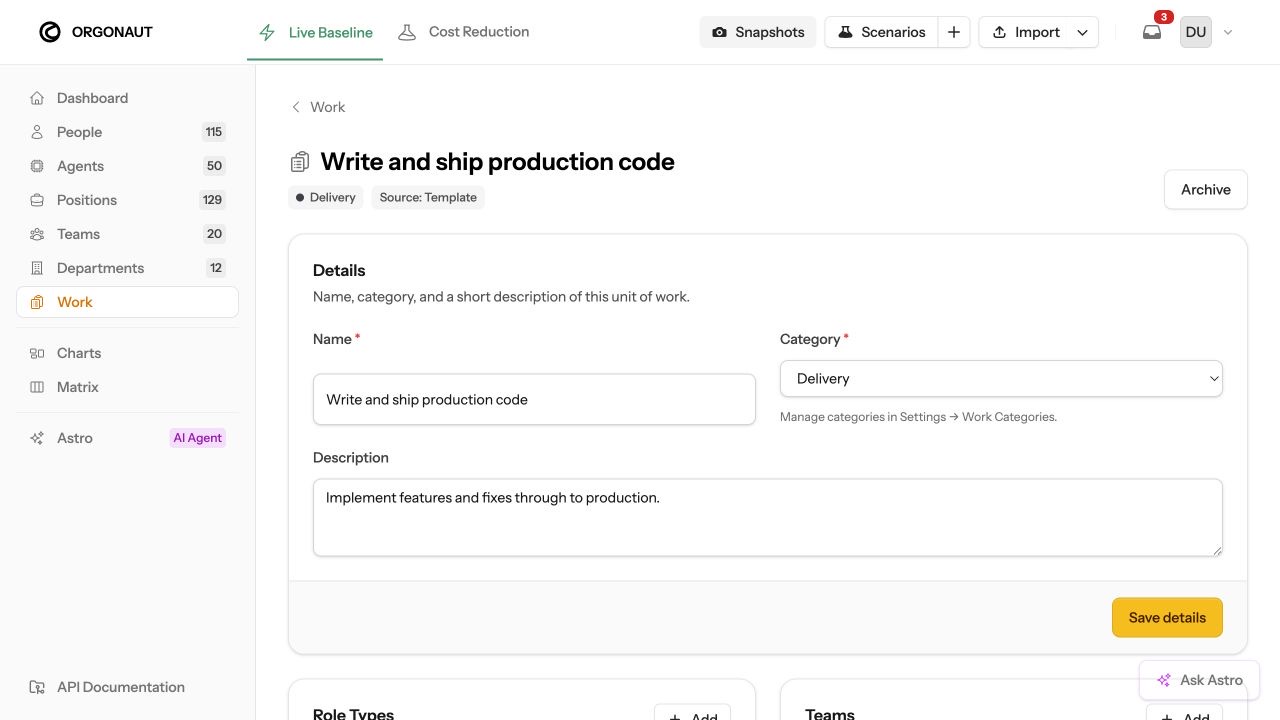
An org chart describes structure. It rarely explains the work taking place inside that structure.
The Work Catalog in Orgonaut adds that missing layer. It records recurring activities and maps them to the role types and teams responsible for them.
Describe the activity once
The example above is a simple activity: Write and ship production code.
It belongs to the Delivery category and has a short definition that everyone can use. The activity can then be mapped to role types such as Engineer, Senior Engineer, Staff Engineer, and Tech Lead, with an estimated share of time for each role.
These percentages are planning estimates. They describe the shape of a role and stay separate from timesheets.
The same activity can also be mapped to teams. A primary mapping shows where the work concentrates, while a secondary mapping records another team that contributes to it.
Start an AI discussion with the work
This becomes useful when a company is deciding where automation or agents can help.
The conversation can begin with a specific activity such as reviewing code changes, triaging incidents, drafting product requirements, or maintaining documentation. From there, the team can examine which roles spend time on it, where it happens, and how a proposed change would affect the operating model.
That is more concrete than treating an entire job title as one indivisible unit.
Build a catalog gradually
New workspaces can load a curated starter catalog of common activities. Each item can be renamed, remapped, or archived as the model becomes more accurate. Astro can also draft a starting catalog from the workspace’s role types, with every proposed activity presented for confirmation before it is added.
The catalog follows the same Live View and scenario rules as the rest of Orgonaut. A scenario can therefore explore how work might move between roles and teams alongside the structural plan.
I think this creates a useful bridge between organisation design and the practical work people are trying to improve. The Work Catalog guide explains the model and the available starting points.